
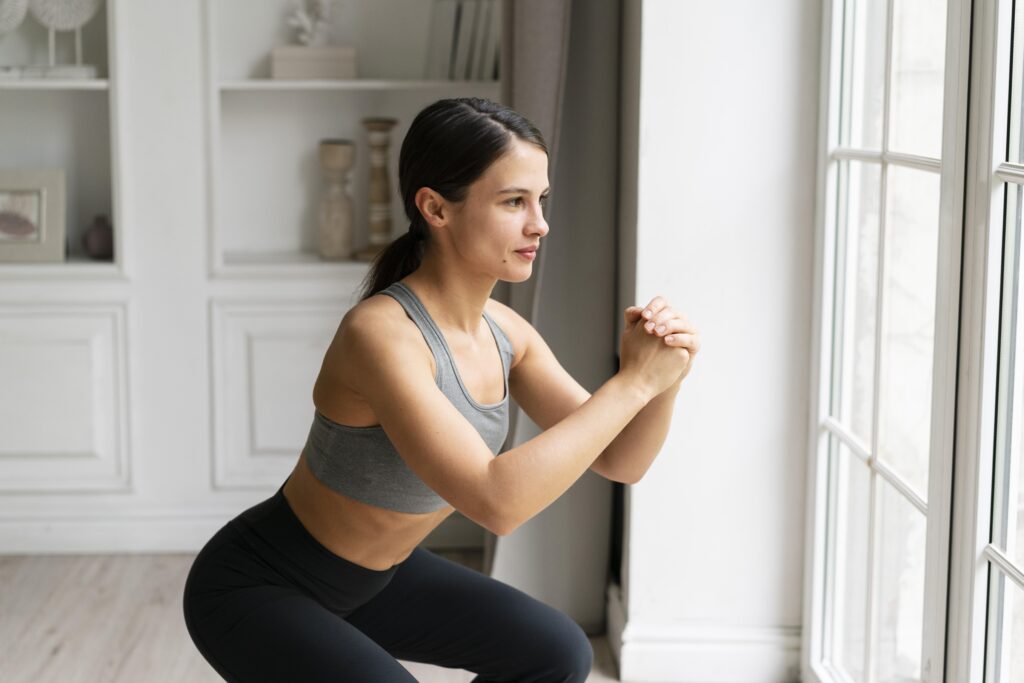
Strong thighs make every step easier, and you can build them with at home quad workouts that need no gym, no machines, and no weights. If you have ever skipped leg day because you had no barbell and no time to travel, this guide is for you.
In this post, you will learn how to do effective at home quad workouts using only your body weight. We cover seven simple exercises, a weekly plan, ways to make each move easier or harder, common mistakes, and what to eat afterward. Whether you are a complete beginner or you already train a little, you can finish these at home quad workouts in 20 to 30 minutes.
Your quadriceps are the biggest muscles on the front of your body. Training them well supports your knees, improves balance, and helps you climb stairs, stand up from a chair, and carry things with less effort. You do not need heavy weights to get started. A smart plan of at home quad workouts, done with good form and steady effort, is enough to see real progress.
Why At Home Quad Workouts Work
Many people think thigh training only counts if you load a bar with heavy plates. That is not true. Your muscles respond to effort, not to the brand of the equipment. When you slowly lower into a squat or hold a wall sit until your thighs burn, your quads are working hard and adapting.
Here are the main reasons at home quad workouts are a great choice:
- It saves time. No commute, no waiting for machines. You can finish your at home quad workouts before your tea gets cold.
- It costs nothing. You only need a clear patch of floor, a sturdy chair, and a wall.
- It is flexible. You can train in the morning, at lunch, or in the evening. If mornings suit you, pair this routine with our morning workout at home for an energizing start to your day.
- It is beginner friendly. You control the pace, the depth, and the number of reps.
- It builds a habit. When training is easy to start, you are more likely to stay consistent.
According to the CDC’s physical activity guidelines for adults, adults should do muscle-strengthening activities that work all major muscle groups, including the legs, on at least two days each week. A weekly round of at home quad workouts is an easy way to meet that goal.
What Do Your Quads Actually Do?
Before you start, it helps to know what you are training. The quadriceps is a group of four muscles on the front of your thigh. Together they straighten your knee, stabilize your kneecap, and help your hip bend.
- Rectus femoris runs down the middle of your thigh and helps both the knee and the hip.
- Vastus lateralis is on the outer thigh and gives your leg its width.
- Vastus medialis is the teardrop shape just above your inner knee. It helps keep the kneecap tracking well.
- Vastus intermedius sits deep under the others and does a lot of the hard work when you stand up.
Knowing these muscles makes at home quad workouts more effective, because you can feel the right area working and stop the effort from shifting to your lower back or knees. A well-planned set of at home quad workouts also supports your glutes and hamstrings, so your whole leg stays balanced and strong.
Before You Start Your At Home Quad Workouts
A few simple steps will make your session safer and more effective.
Warm Up for Five Minutes
Never jump straight into squats with cold muscles. Spend five minutes on a gentle warm-up:
- March in place for one minute.
- Do 10 slow leg swings on each side, holding a wall for balance.
- Do 10 hip circles in each direction.
- Do 10 shallow bodyweight squats to wake up your knees and hips.
- Finish with 10 ankle rolls on each side.
Prepare Your Space
You need about two meters of clear floor. Wear shoes with a flat sole or go barefoot on a non-slip surface. Keep a sturdy chair and a wall nearby, because you will use them for several moves.
Learn the Basic Form Rules
- Keep your chest lifted and your back straight.
- Push through your whole foot, especially your heels.
- Keep your knees in line with your toes. Do not let them cave inward.
- Move slowly. Take two to three seconds to lower and one to two seconds to rise.
- Breathe out as you push up and breathe in as you lower.
If you feel sharp pain, stop. Mild muscle burn is normal, but pain in a joint is a warning sign. If you have a knee, hip, or back problem, speak with a doctor or physical therapist before you begin any at home quad workouts.
The 7 Best At Home Quad Workouts
Do these seven moves in order. Rest 30 to 45 seconds between sets and about one minute between exercises. If you want help choosing how hard to push, the Mayo Clinic’s strength training guide explains how to pick a challenging but safe effort.
1. Bodyweight Squats
The squat is the king of all at home quad workouts. It trains your quads, glutes, and hamstrings together.
How to do it:
- Stand with your feet shoulder-width apart and toes turned slightly out.
- Push your hips back and bend your knees as if you are sitting into a chair.
- Lower until your thighs are parallel to the floor, or as far as you can go with good form.
- Press through your heels to stand tall and squeeze your glutes at the top.
Sets and reps: 3 sets of 12 to 15 reps.
Tip: If your heels lift off the floor, place a small folded towel under them or reduce the depth until your mobility improves.
2. Split Squats
Split squats train one leg at a time, so they fix strength gaps between your left and right sides. They are a staple of good at home quad workouts because they load the front thigh without any equipment.
How to do it:
- Stand in a long stride with your right foot forward and your left foot back, heel lifted.
- Lower your back knee straight down toward the floor.
- Keep your front shin nearly vertical and your front heel flat.
- Push through your front foot to rise.
- Finish all reps, then switch sides.
Sets and reps: 3 sets of 10 reps per leg.
Tip: Hold a chair or wall with one hand if your balance feels shaky.
3. Wall Sit
The wall sit is one of the simplest at home quad workouts. It is an isometric move, which means you hold a position instead of moving. It builds muscular endurance in your thighs and needs only a wall.
How to do it:
- Stand with your back against a wall and walk your feet forward about 60 centimeters.
- Slide down until your knees are bent at about 90 degrees.
- Keep your back flat against the wall and your weight in your heels.
- Hold, then slide back up.
Sets and time: 3 holds of 20 to 40 seconds.
Tip: Rest your hands on your thighs or let them hang. Do not push on your knees.
4. Step-Ups
Step-ups copy the movement of climbing stairs. They build single-leg strength and work your quads, glutes, and hamstrings together.
How to do it:
- Stand in front of a sturdy chair, a bench, or the bottom stairs.
- Place your right foot fully on the step.
- Push through your right heel and stand up straight, bringing your left foot up beside it.
- Step back down with control, leading with the left foot.
- Finish all reps, then switch legs.
Sets and reps: 3 sets of 10 reps per leg.
Tip: Make sure the chair will not slide. Place it against a wall for safety.
5. Reverse Lunges
Reverse lunges are easier on the knees than forward lunges, which makes them a smart choice for beginners. They work your quads and glutes and improve balance.
How to do it:
- Stand tall with your hands on your hips.
- Step your right foot back and lower until both knees form roughly 90-degree angles.
- Keep your front knee above your ankle.
- Push through your front heel to return to standing.
- Repeat on the other side.
Sets and reps: 3 sets of 10 reps per leg.
Tip: Hold the back of a chair if you feel wobbly. Balance improves quickly with practice.
6. Bulgarian Split Squats
This is the hardest of the at home quad workouts in this list, so save it for when the earlier moves feel comfortable. Your back foot rests on a chair, which puts more of your weight on the front leg.
How to do it:
- Stand about one big step in front of a sturdy chair, facing away from it.
- Place the top of your back foot on the seat.
- Lower your back knee toward the floor while keeping your chest up.
- Drive through your front heel to stand.
- Finish all reps, then switch legs.
Sets and reps: 3 sets of 8 reps per leg.
Tip: If the move bothers your knee, shorten the range of motion or return to regular split squats.
7. Cyclist Squats
Cyclist squats use a narrow stance and a raised heel to push the work into the front of your thighs. They finish your at home quad workouts with a strong burn.
How to do it:
- Place your heels on a folded towel or a thin book, with your feet close together.
- Keep your chest tall and your arms out in front for balance.
- Lower slowly for three seconds, letting your knees travel forward over your toes.
- Press back up through the whole foot.
Sets and reps: 3 sets of 10 to 12 reps.
Tip: Use a wall or chair for light support until you feel steady.
A Weekly Plan for At Home Quad Workouts
You do not need to train your thighs every day. Muscles grow during rest, so two or three sessions per week is plenty. Here is a simple plan:
- Day 1: Full at home quad workouts (all 7 exercises)
- Day 2: Upper body day. Try our triceps workouts at home or upper chest workout at home.
- Day 3: Light walk or stretching
- Day 4: Short at home quad workouts (squats, wall sit, reverse lunges)
- Day 5: Back and core. Use our home workout for back without equipment.
- Day 6: Full at home quad workouts again, with one extra set per exercise
- Day 7: Rest
If you want a full weekly structure that covers your whole body, see our 7 day workout plan at home and slot these thigh days into it.
How to Make At Home Quad Workouts Easier or Harder
Your body adapts quickly. To keep improving, change the difficulty over time.
For Beginners
- Reduce the depth of squats and lunges.
- Hold a chair for balance.
- Do 2 sets instead of 3.
- Skip the Bulgarian split squats for now.
Start here for the first two weeks. A gentle round of at home quad workouts done with good form beats a hard one done badly.
For Intermediate Levels
- Add a fourth set.
- Slow your tempo to four seconds on the way down.
- Pause for two seconds at the bottom of each squat.
- Fill a backpack with books and wear it for squats and step-ups.
For Advanced Levels
- Add jump squats and jumping lunges for power.
- Reduce rest time to 20 seconds.
- Try slow single-leg sit-to-stand reps from a low chair.
- Use water bottles, a heavy bag, or resistance bands for extra load.
A good rule is to add one small challenge at a time. When all your sets feel easy, it is time to make your at home quad workouts a little harder.
Common Mistakes in At Home Quad Workouts
Even simple exercises can go wrong. Watch out for these frequent mistakes.
- Skipping the warm-up. Cold muscles are stiff and more likely to get hurt.
- Letting your knees cave in. This puts stress on the knee joint. Think about pushing your knees out over your little toes.
- Rushing your reps. Fast, sloppy reps use momentum instead of muscle. Slow down.
- Lifting your heels. Weight on your toes shifts stress to your knees. Keep your feet planted, except where a move asks for a raised heel.
- Doing the same routine forever. Progress by adding reps, sets, or a slower tempo.
- Ignoring rest days. Sore thighs need time to rebuild. Two days of rest per week is healthy.
- Forgetting to stretch. Spend three to five minutes stretching your quads, hamstrings, and calves after you finish.
Avoiding these errors will make every one of your at home quad workouts safer and more productive.
What to Eat Around Your At Home Quad Workouts
Food helps your muscles perform and recover. About 30 to 60 minutes before training, eat something light with carbohydrates for energy, such as a banana or a small bowl of oats. If you like a drink instead, try one of the options in our pre workout drink at home guide, which needs no supplements.
After your session, your muscles need protein and carbohydrates to recover. Good choices include Greek yogurt with fruit, eggs on whole-grain toast, a glass of milk with a handful of nuts, or a simple smoothie. For more ideas, browse our list of healthy protein snacks that keep you full and support muscle repair.
Drink water before, during, and after your at home quad workouts. Even mild dehydration can make your legs feel heavy and tired.
Frequently Asked Questions About At Home Quad Workouts
How often should I do at home quad workouts?
Two to three times per week is ideal for most people. Leave at least one rest day between hard sessions so your muscles can recover and grow.
Can I build strong quads without weights?
Yes. Bodyweight exercises can build strength, especially for beginners. Once your body adapts, you can slow your tempo, add reps, use single-leg moves, or load a backpack to keep progressing in your at home quad workouts.
How long do at home quad workouts take?
Most routines take 20 to 30 minutes, plus five minutes for warm-up and a few minutes for stretching. A short, focused session done consistently beats a long one you skip.
Are at home quad workouts safe for my knees?
For most healthy people, yes, when you use good form and build up slowly. Keep your knees in line with your toes and avoid pain. If you have a knee injury or ongoing pain, ask a doctor or physical therapist which moves suit you before you begin.
Is it normal to feel sore after at home quad workouts?
Mild soreness for one to three days is normal, especially when you are new to training. Gentle walking and stretching can help. If you feel sharp pain or swelling, stop and speak to a medical professional.
Final Thoughts
You do not need a gym to build strong, capable thighs. With just your body weight, a chair, and a wall, you can follow a complete set of at home quad workouts that trains every part of your quadriceps. Start with the seven exercises in this guide, use the weekly plan to stay consistent, and make small improvements every week.
Begin with the beginner version, focus on form, and give yourself time. In a few weeks, you will notice that stairs feel easier, your balance improves, and your legs feel stronger. Save this post, share it with a friend who wants to start training, and do your first at home quad workouts today.
Disclaimer: This article is for general information and is not medical advice. Talk to your doctor before starting a new exercise program, especially if you have an injury or a health condition.